
Do you know the difference between assets and liabilities? It is simple, and I will explain it all clearly. Whether you are self-employed (OSVČ), run a business under another legal form, or are an accounting student who needs it for your school-leaving exam, this article is for you. Knowing what assets and liabilities are is the foundation. Let’s get started.
Table of contents
Assets = property
Assets are everything a business owner owns. They can be non-current or current assets.
Non-current assets
Non-current assets wear out over time, which is why they are depreciated. We divide them into tangible non-current assets (movable and immovable things you can touch) and intangible non-current assets (software, licences). Non-current assets also include non-current financial assets, which a sole trader or business owner holds for longer than one year and for which the acquisition cost does not matter.
Current assets
Unlike non-current assets, current assets circulate through the business (they move around it) and are usually used for one-off or quick consumption (cash, money in a bank account, stamps and vouchers). These are assets that are used up within one year.
Acquisition cost of assets
Another criterion for classifying assets is their acquisition cost. If you bought an asset such as a car or a machine for over 40,000 CZK (about 1,800 USD), it is a tangible non-current asset. If you acquired this house or plot of land for less than 40,000 CZK (about 1,800 USD), it is a low-value tangible non-current asset.
The same applies to intangible non-current assets, but the acquisition cost limit is different: here it is 60,000 CZK (about 2,800 USD). If an intangible non-current asset (for example software) cost over 60,000 CZK (about 2,800 USD), it is an intangible non-current asset. If it was cheaper, we classify it as low-value tangible assets.
Depreciation of non-current assets
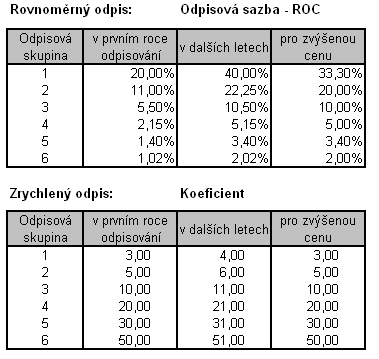
There are two types of depreciation: accounting and tax. And then, of course, straight-line (linear) and accelerated (declining). Depreciation is rounded up to whole crowns. Accumulated depreciation is the term for all depreciation charged so far. For straight-line depreciation we use the depreciation rate, for accelerated depreciation the depreciation coefficient. There are tables for both values (see the image below).
Straight-line depreciation
Apart from the first year, we always depreciate the same amount.
o1 = PC. s1 /100
on = PC. s2 /100
PC = acquisition cost
s1 = rate in year 1
s2 = rate in subsequent years
Accelerated depreciation
We depreciate more in the first years and less in later years.
o1 = PC / k1
on = 2.ZC / k2-n
k1 = depreciation coefficient in year 1
ZC = residual value
k2 = depreciation coefficient in subsequent years
n = number of years you have already depreciated
o9 → n = 8
o35 → n = 34
Short-term (current) assets
Current assets are also called circulating assets for short, or financial assets. Besides money itself, they include (short-term financial assets, which cover various securities such as bonds or shares valid for up to one year). We also count receivables here (that is, a relationship between the business owner and another party in which the business owner has not been paid on time). Inventory (materials and goods) also falls under current assets.
Watch out! Receivables are also an asset!!! People often get this wrong. Never classify receivables as liabilities. Only payables belong under liabilities. The difference is that a receivable means someone owes you, whereas a payable means you owe someone.
Liabilities = ways of financing assets
The sources from which assets (property) are financed are called liabilities. They are divided into own and external sources. In the first case, these can be share capital, funds or the profit or loss (profit). In the second case, bank loans, which the business owner must repay. However, you have to allow for interest. Payables and provisions also belong here.
Own sources of financing
Share capital is all the resources put into the business (cash and non-cash contributions). It works as a permanent part of the assets.
A business can also be built up from profit or further contributions. Examples include the Reserve Fund (Rezervní fond), the Bonus Fund (Fond odměn) and the Cultural and Social Needs Fund (Fond kulturních a sociálních potřeb).
A business owner can, of course, also pay for assets out of profit. We find out this profit or loss from the balance sheet, which is discussed below.
External sources of financing
First of all, this includes loans. These are borrowings from financial institutions or from other businesses and individuals. Another way to finance a business is through payables. These are the business owner’s debts. The business owner is a debtor to
- suppliers,
- employees,
- the state.
To cover its future expenses, a company creates what are known as provisions. These are the last way of financing assets.
💡Tip: Are you a business owner who would like to minimise expenses? Read our article How to cut costs?
Balance sheet
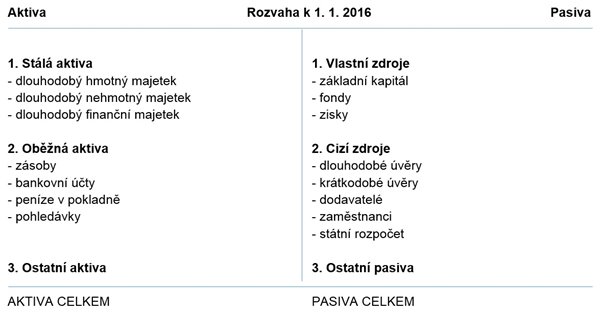
A balance sheet is a kind of “T” (see the image), with assets on the left side and liabilities on the right. Remember that the totals must be identical, which means that assets must equal liabilities. A balance sheet is usually drawn up at the beginning or end of an accounting period. We write the date on the horizontal part (the top) of the letter T.
The opening balance sheet is drawn up at the start of bookkeeping. Then the individual transactions are posted to the appropriate accounts according to the chart of accounts. Because double-entry bookkeeping is used today, you must record each transaction in two accounts (small “T”s), but on opposite sides. The result is the profit or loss (HV), the same on both sides of the balance sheet.
A business owner must be able to tell assets and liabilities apart instantly, just as if someone woke you at three in the morning and asked you the times tables or the basic spelling rules every schoolchild learns.
The left side of the letter T is called Debit (Má dáti), the right side Credit (Dal). These names have nothing to do with the verb “dát” (to give).
Types of balance sheet
The basic division is into ordinary and extraordinary balance sheets. An ordinary one is drawn up on a set date, while an extraordinary one is drawn up in unusual situations (on the day of liquidation, in a merger (when businesses combine) or in bankruptcy).
Balance sheets by point in time
The founding balance sheet is used when a business is set up, as at the date it comes into existence. A sole trader draws up the opening balance sheet at the beginning of the accounting period, typically as at 1 January. The closing balance sheet, by contrast, is used at the end of the accounting period (as at the last day of the year).
Between drawing up the individual balance sheets, entries are posted to small accounts (miniature “T”s).
Purpose of the balance sheet
Why do we draw up a balance sheet? It gives an overview of the assets and the sources that finance them. It also gives us information for assessing the company’s financial situation. The balance sheet also makes it possible to find the profit or loss, which the business owner discovers by comparing all the balance sheets. If revenue is greater than costs, we call it a profit. If it is the other way round, there has been a loss.
Basic balance sheet terms
Accounting has many technical terms, and the balance sheet is no exception. Which ones do you need to know?
1) Balance sheet date
This is the date as at which the balance sheet is drawn up. It depends on when we prepare it. This date is written at the top of the letter T.
2) Balance sheet amount
This is the monetary value of the individual assets and liabilities in the balance sheet (for example the amount for buildings). It is written with dots (for example 10.000).
3) Balance sheet item
This, by contrast, is the written name of the individual assets (A) and liabilities (P) in the balance sheet.
4) Accounting period
This is the period between balance sheet dates (between the opening and closing balance sheets).
5) Closing line (zámezovka)
A closing line is a line we draw through the empty rows of the balance sheet. It prevents anything from being added later. The line must be straight, not jagged, with no “steps”.
How to draw up a balance sheet
First, draw a large T in pencil. At the top, write Balance sheet as at… In place of the dots, give a specific date, for example 1 January 2021.
Assets go on the Debit side and liabilities on the Credit side. Be systematic about it. For assets, start with non-current assets, continue with current assets and so on. For liabilities, record share capital first, then funds and finally profit.
Once you have entered all the assets and liabilities, draw a horizontal line and cross out any empty spaces with a closing line. Below the line, write the total sign and you will get the profit or loss, the same on both sides. Cross out the remaining empty space with a line again.
The video clearly shows how to draw up a balance sheet step by step. It focuses on a household balance sheet.
Basic changes to balance sheet items
We record changes on balance sheet accounts by writing only assets on asset accounts and only liabilities on liability accounts. The difference, however, is that increases in assets (+) go on the left side (Debit), while decreases go on the right side (Credit). Liability accounts work the other way round: increases are written on the Credit side and decreases on the Debit side. For both asset and liability accounts, we write the opening and closing balances on the side used for recording increases.
Each transaction must be recorded in two opposing accounts, but on different sides (one on the left, the other on the right). This is how we follow the rule of double-entry bookkeeping and make sure the entries are correct.
Example
A business owner has received a bank statement for paying a supplier’s invoice. The sole trader must record this transaction in a small T-account. Because money has left their bank account, the first account to post to is the Bank Account, which is an asset account. The decrease must therefore be entered on the Credit side. On the second account we post the opposite way, on the Debit side. Which account will it be? Suppliers, because that is where our liabilities to suppliers belong.
However, if we had a payable to a supplier (for example, we received an invoice from a supplier for a purchase of materials), we would also post to account 321, Suppliers, but on the opposite side (Credit). The contra account would be the asset account Materials in Stock, so we would record the amount on the Debit side.
Account = konto
During the accounting period (AP), we need information about the changes that occurred during that period. That is why we set up a small account for each balance sheet item. Like the balance sheet, it has the shape of the letter T. Each account has its own number and name, which you can find in the Standard Chart of Accounts (Směrná účtová osnova).
Standard Chart of Accounts
The chart of accounts is a two-page table where a student or business owner can find the numbers and names of individual accounts so they can enter them in a small T-account. It contains 10 account classes (0–9), which are further divided into account groups. Account classes have one digit (1, Inventory), while account groups have two digits (11, Materials).
Exercise, can you tell what belongs to assets and what to liabilities?
See whether you can tell assets and liabilities apart. Check that you have understood my explanation by watching this video. It contains several examples that you need to assign to either assets or liabilities.
Assets are property used only for business.
More articles about business
- What business can you start in a village?
- How clothing rental services help business
- Being an employee was a waste of time for me
- Digital nomads in the time of coronavirus
Summary
Everything a company owns is an asset. It can be long-term or short-term property. Liabilities, on the other hand, show how business owners finance their assets.
The balance sheet is used to record assets and liabilities. We draw it up in the shape of a T. Thanks to the balance sheet, we have an overview of the financial result.
Remember that assets and liabilities must be equal on the balance sheet. This means that the Debit side (the left part of the balance sheet) will always show the same total as the Credit side (the right part of the balance sheet).
Read our tips for the best Christmas gifts as well. Find inspiration in modern prose from contemporary literature and read books yourself over Christmas, or give them to your loved ones. Finally, take a look at our article on how to take stock of your life at the end of the year.
USD amounts are approximate, converted at the Czech National Bank rate of 21.75 CZK per USD on 9 October 2026.