
I think Portugal is an underrated country in travel circles. I rarely hear of anyone going to Portugal on holiday, let alone to live. Yet this country offers beautiful nature, sunny weather, a European base and good conditions for longer stays too. What is life like for a freelancer on the south-western tip of Europe?
Table of contents
Portugal from a freelancer’s point of view
Many digital nomads choose popular Asian countries for their travels. These countries are made for this lifestyle, as they offer a life of luxury and exotic surroundings at a really low cost of living. However, 2020 closed off most of the world, and with it the chance to travel.
Perhaps the difficult Covid situation also upset your travel plans. Believe me, I understand that only too well. We were in the same situation, but we did not give up on our dream of living abroad long term and adjusted our vision instead.
We chose Portugal, and now I will tell you what the life of a freelancer is like in this beautiful country on the Iberian Peninsula. What do food and rent cost here, where can you find long-term accommodation and which places should you not miss when visiting Portugal?
Tip from Žij Úspěšně: Also read our article on digital nomadism during the coronavirus pandemic.
What does Portugal offer?
Portugal is a varied country where everyone will find something for themselves. Within Europe, it is one of the best options for living long term. This is thanks to costs comparable to those in Czechia and the whole range of attractions and opportunities you will find here.
Surf lovers will be in their element
Portugal is surrounded not by a sea but by an ocean. You will notice the difference in the water temperature, which is much lower than the sea even in summer (about 21 degrees), and also in how wild it is. The ocean almost never seems calm, quite the opposite.
However, the endless waves create great conditions for surfers, whom you will meet on every beach. This also means it is easy to find places to hire wetsuits, surfboards, kayaks and paddleboards.
Some beaches are packed with surfers every day (even in the winter months). Even so, you can still find less touristy beaches where you will have plenty of space for your surfing tricks.
The beauty of nature
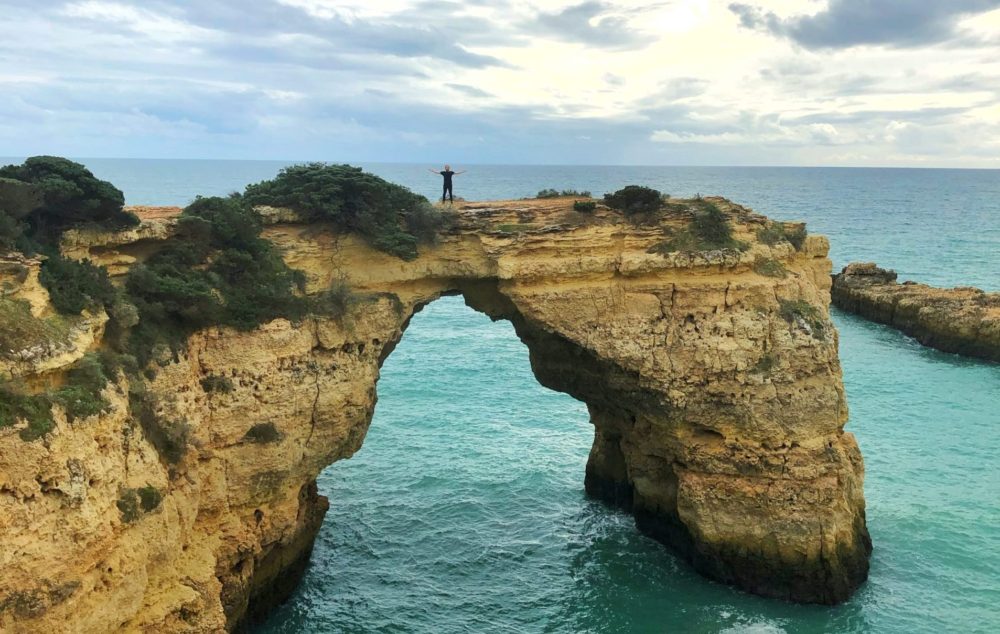
High cliffs, yellow sandy rocks and spring-green countryside all year round, that is Portugal. You will find hundreds of beaches along the entire coast, and they often offer complete privacy. There are so many to choose from that it is easy to find your own private beach.

Do not be afraid to explore the various tunnels, rocky nooks and overhangs, because these secret entrances often lead to secluded sandy beaches just for you. I recommend exploring the beauty of the cliffs not only from below but also from the top. It is a real experience from both perspectives.
Portugal also gives you the chance to see dolphins and whales in the wild, if you are lucky. In the fairly short time we have lived here, we have already seen dolphins twice, once from a distance off the coast and once when we took a boat out onto the open ocean. After just 20 minutes, several dolphins were already playing in the waves from our boat.
If you like cycling, I recommend exploring the Portuguese hills by bike. I promise you will get a proper workout. Also worth mentioning are the iconic white and blue houses typical of the coastal areas. In Portugal’s narrow streets, you will hardly see any other type of architecture.
Make sure you visit:
- Lisbon (the whole city offers many sights, the famous Lisbon bridge and a pleasant base)
- Sagres
- Carvoeiro
- Benagil
- Lagos and the surrounding area
- Praia de albandeira
- Portimao
- Silves

Security and safety
If I look at travelling in Portugal from a safety point of view, it is a very calm and pleasant destination. People here are friendly and in most areas you can get by well in English (even so, there are places where English will not get you far).
In smaller towns, people greet each other on walks even if they do not know each other. So you will quickly learn a simple Oi or Olá.
You feel really safe here, with no risk of theft and the like. You will very quickly get used to the friendly local atmosphere and the sense of security.
The financial side of living in Portugal
Have you decided to move abroad and want to know about the financial side of life in Portugal? What costs can you expect for rent, food or utilities?
Portugal is one of the cheapest destinations in Europe, and even in the world overall. Total costs per person here are very similar to those in Czechia. This makes it a suitable country for first-time travellers or for long-term stays.
Of course, it depends on your lifestyle and your preferences. Both low-cost travellers and people who like to treat themselves will find what they are looking for here.
1/ Rent
Rents for flats and houses depend mostly on the exact location. The more flexible your requirements, the better the rent you can get. When looking for accommodation for more than two months, the prices we came across most often were 420 to 550 euros a month including utilities.
2/ Food and cosmetics
You will find similar supermarket chains to those in the Czech Republic (we can recommend Lidl, Continente and Aldi, for example), but in larger towns you will also find markets and zero-waste shops. Food costs about 10 to 30% more than in Czechia. The conversion from crowns to euros naturally plays a part in this too. Simply put, you will find very few items under 1 euro here.
Cosmetics cost much the same as in Czechia. There are no traditional chemists here, but every shop has a cosmetics section. Some products (vitamins, dietary supplements and so on) are only available in pharmacies.
3/ Transport and petrol
Bus and train services work very well here. You will also find companies such as Uber and Bolt. Public transport costs are not much different from those in Czechia, but the price of petrol came as a rather unpleasant surprise. One litre of fuel cost about 50% more than we are used to in the Czech Republic.

Portugal in autumn and winter, is it worth going?
We set off for Portugal in autumn and so extended our summer. At a time when we would be getting out hats and light jackets at home, we were still walking around here in T-shirts and often even in swimwear.
The autumn and winter months in Portugal bring pleasant temperatures of around 15 degrees. It is rather like our spring: one day it rains, the next the sun shines. It should also be said that it can easily feel like 23 degrees even in December. Ideal weather for lovers of warmth and sunshine.
I recommend checking in advance whether your accommodation has heating, as it is often colder indoors than outside and the Portuguese are not usually prepared for a drop in temperature. Houses often have no heating at all, and by February that is not very pleasant.
Where to find accommodation?
Many Portuguese people make a living by renting out their properties. You will find great flats and houses on standard platforms such as Airbnb or Booking, but I also recommend joining various Facebook groups and asking for accommodation there. That is exactly how we found an affordable, furnished house by the beach in a small fishing village, and as a bonus, it is rented to us by a Czech woman who lives with a Portuguese man. A great combination for gaining your first experience.
Overall, I can recommend this destination. It can also be a great alternative for freelancers and digital nomads in these difficult times for travel. If you would like to know anything else, feel free to ask in the comments below the article.

