

How much energy do we spend every day trying to fix our weaknesses? Time management courses, confidence workshops, self-help bibles on productivity… But what if we are pushing hard in areas that simply are not our thing, instead of developing what we already have naturally? The Gallup strengths test helps individuals and teams discover their natural talents and focus their energy where their real potential lies.
This is a philosophy that changes how we think about personal growth. It helps people discover their zone of excellence and finally start using it to the full. Whether you are a freelancer, a team manager or a parent looking for a new direction, once you know what truly makes you exceptional, you stop comparing yourself to others and start to grow.
“I knew I enjoyed organising things and taking on challenges. But it was the test that showed me my strengths are not something to take for granted. They are something I can develop and build my career on.” (Pavlína, sales assistant)
Table of contents
What is the Gallup test and why should you care?
Gallup’s approach to identifying strengths grew out of fifty years of research led by Dr Donald Clifton and Marcus Buckingham. The result is a test known as CliftonStrengths (formerly StrengthsFinder), which has become a globally recognised tool for developing people and leading teams.
The test is taken online and helps you name and understand your natural talents. It does not focus on your weaknesses but on where you shine, and on how you can work with that consciously.
Unlike other personality typologies, it does not put you in a single box. Instead, it gives you a way to describe your inner potential.
The test is used in more than 160 countries and has had over 30 million users. Perhaps more importantly, its impact is measurable. According to Gallup’s data:
- companies that make use of their people’s strengths have 7 times higher employee engagement,
- they achieve 21% higher profitability,
- team productivity rises by 8–18%,
- staff turnover falls by 20–73%,
- and participation in philanthropic activities is 4–10% higher.
“Everyone has an incredible amount of potential to build on. Not castles in the air, but a beautiful and fulfilling life, if they know what they are best at.” (Marianna Seman, Gallup Certified Strengths Coach)
Curious about your natural strengths?
Discover them with a talent test. On the Use Your Talents website you will find a tool to help you get started, and a community to support you on your path to growth.
What does the test itself look like?
One of the most common mistakes in personal development is focusing on weaknesses. Yet where natural talent is missing, growth is always limited. Don Clifton, the founder of strengths-based psychology, showed on the basis of decades of research that investing in strengths brings a much higher return.
He turned this approach into the CliftonStrengths® tool, a questionnaire of 177 pairs of statements that assesses how you naturally think, feel and act. It takes 30–45 minutes to complete, and the result is a unique profile of your 34 talents.
You get an overview of which talents dominate in you, your so-called signature talents (Top 5), as well as which ones are supporting and which come less naturally. The chance that someone else has the same five talents in the same order as you is 1 in 33 million. That is how unique you are!
A talent is not a skill. It is not about what you can do, but about how you naturally function. When you work with your talents consciously, they turn into real strengths.
Your talents and strengths show in the way you think, behave and make decisions. This affects your ability to work and complete tasks, analyse information and make decisions, and build relationships with other people. The method helps individuals in their personal and working lives, as well as managers, teams and companies.
The four talent domains, where do you shine?
Each of the 34 talents falls into one of four categories, known as domains. These are the four basic areas in which people use their natural abilities. They help us understand how we think, act and work with others. Once you know which domain is strongly represented in you, it is easier to see why some activities come “naturally” to you while others wear you out.
- Executing: People whose talents lie mainly in this domain know how to actually get things done. They are reliable, systematic and results-oriented. They can plan, organise and keep their word. Typical talents include Responsibility, Discipline and Achiever.
- Influencing: If you shine in this area, you have a gift for influencing others, persuading them and spurring them into action. You present your ideas well, you are not afraid to be seen and you can inspire people. Talents in this domain include Self-Assurance, Competition and Communication.
- Relationship Building: This domain covers people who naturally build strong bonds with others. They create an atmosphere of trust, support team spirit and are attentive to other people’s needs. Talents here include Empathy, Harmony and Individualization.
- Strategic Thinking: This domain is strong in people who like to explore, analyse and look for deeper connections. They need to understand the world, learn and create visions. It includes talents such as Strategic, Learner and Input.
Once you discover which of these domains is your “home ground”, you will better understand why some tasks energise you while others drain you. It will also be easier to decide which direction to take, both professionally and personally.
How does talent development work?
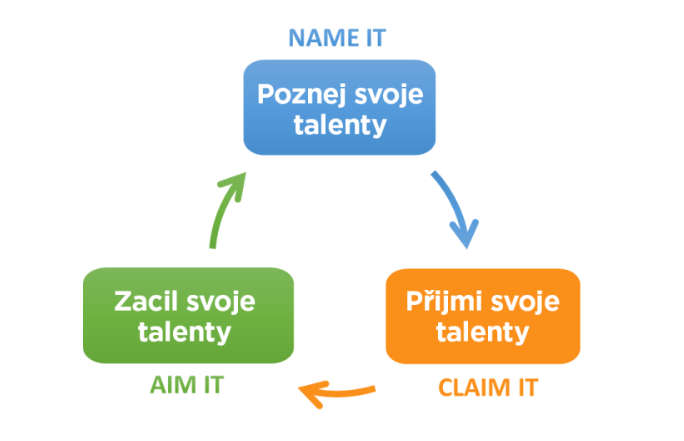
- Discover: Get to know your talent profile.
- Accept: Stop comparing yourself and start growing.
- Focus: Develop specific talents in practice.
Working with a qualified coach is about more than a printout of your results. It is a process of deeper self-knowledge, self-acceptance and targeted development. Clients often say that this journey finally helped them understand themselves: why they react in certain ways, how others see them and where they feel most “comfortable in their own skin”.
What the test does (and does not) tell you, and why that is fine
The Gallup test is not a label or a diagnosis. It will not tell you what to do or who to be. But it will help you understand how you function when you are at your best.
“I found out that my Empathy talent is not a weakness but a resource. I learned how to use it in my work with clients and in my personal relationships.” (Barbora, trainer and coach)
Talent is raw potential. Strength only comes with conscious development. The test gives you a guide to thinking about yourself and growing.
When stories speak
“After my sports career ended, I hit rock bottom. The Gallup test helped me see that I have something to offer off the track too. I discovered my Ideation talent, and today I run a training programme for young athletes.” (Gabriela, motorcyclist and mentor)
“When my son thought he was average and not good at anything, the test showed him that wasn’t true. His self-confidence went up.” (Marianna, coach and mum)
Stories like these show that this is not a one-off test but a lasting change in awareness and in how you approach yourself.
When strengths become a strategy
Most HR managers today are looking for ways to support team satisfaction, loyalty and performance. Gallup’s approach is proving to be an effective tool:
- Higher engagement: Employees who know their talents have a clearer direction and stronger inner motivation.
- Better collaboration: Team members complement each other better and understand each other’s strengths.
- Lower turnover: It makes sense for people to stay where they can excel.
For example, the company AVAPS has built the Gallup test into the onboarding of new colleagues. According to its management, this has led to better team alignment and greater efficiency.
Looking for a more effective way to develop your team?
Companies that know their people’s strengths achieve higher engagement, stability and performance. Find out more about team testing and talent development.
What to do with your test results next
Getting your results is only the first step. The real benefit comes when you learn to use your talents consciously, in your daily work, in your team and at home. Each of the 34 talents shows itself in its own way. Some will help you plan brilliantly, others excel at building relationships, and others naturally lead people or focus on results.
It is not about having “good” or “bad” talents. It is about understanding which ones you have, and what you can do with them.
“I found out that my top 5 includes talents such as Empathy and Developer. Suddenly it made sense why working with people is so fulfilling for me and why it matters to me to see their progress. I stopped trying to be someone else.” (Klára, HR specialist)
This is the magic of working with strengths: you start to understand not only yourself but others too. It is a relief to realise you do not have to be good at everything. And teams that build on talents work with more trust, efficiency and respect.
Next comes everyday work with your talents:
- Coaching with a certified coach
- Joining a community
- Personal reflection and linking your results to real-life situations
Many participants value the chance to share experiences in closed groups or community meetings. This exchange of perspectives often brings new “aha” moments that the test results alone cannot offer.
Talent is the beginning, and growth comes with support.
Whether you want to follow up on your results with individual coaching, a course or by joining the community, at Use Your Talents you will find all the options for truly using your potential.

What happens when you start building on what you are good at?
Perhaps you know the feeling. For years you have been trying to “improve” your presentation skills, even though your knees shake every time you speak in public. Or you force yourself into systematic planning because “that is what successful people do”. Yet perhaps you bring something completely different to the team, such as the ability to connect people, sense the atmosphere or find new solutions.
According to Gallup research, people who consciously use their strengths:
- Have higher levels of self-confidence and well-being
- Feel more engaged and satisfied at work
- Cope better with stress and change
- Experience flow more often (a state of deep focus and enjoyment of the activity)
That is no small thing. And when this starts happening systematically across an organisation, it changes the company culture from the ground up. Suddenly the question is not who cannot do what, but who excels at what. And who can form a stronger whole with whom.
“When we started sharing our top 5 talents in the team, a whole new level of understanding opened up. We now know why unfinished tasks stress one person while another needs to let things mature. We stopped arguing and started complementing each other.” Lukáš, development team lead
Self-knowledge is not a luxury
Developing your strengths is not a whim. It is the most effective way to fulfil your potential, whether you are a student, a parent, a manager or an HR specialist.
The Gallup test does not offer instant instructions. But it does offer a map. And it is up to you whether you set out to look for the treasures that are already inside you.
📌 Think about it:
- In which situations do you feel comfortable in your own skin?
- What comes naturally to you, without you having to try?
- And what if you started building on exactly that?
You are not just one of many. You are a unique mosaic made up of talents that deserve to be discovered and understood.
“You cannot be anything you want to be, but you can be a lot more of who you already are.” (Tom Rath)
Not sure whether the Gallup test is right for you? Let the idea sit with you for a while. Perhaps all it takes is a first step: simply reading more, talking to someone who has taken the test, or asking a colleague how their company works with talents.
Knowing your talents is not a dogma but a starting line. You can build your personal brand on them, choose projects that suit you, or finally find a job where nobody forces you to be someone else. And if you lead people, it can change how you approach motivation, development and feedback.
Discover what drives you. Not so that you can be perfect, but so that you can be more yourself, and at your very best.

