
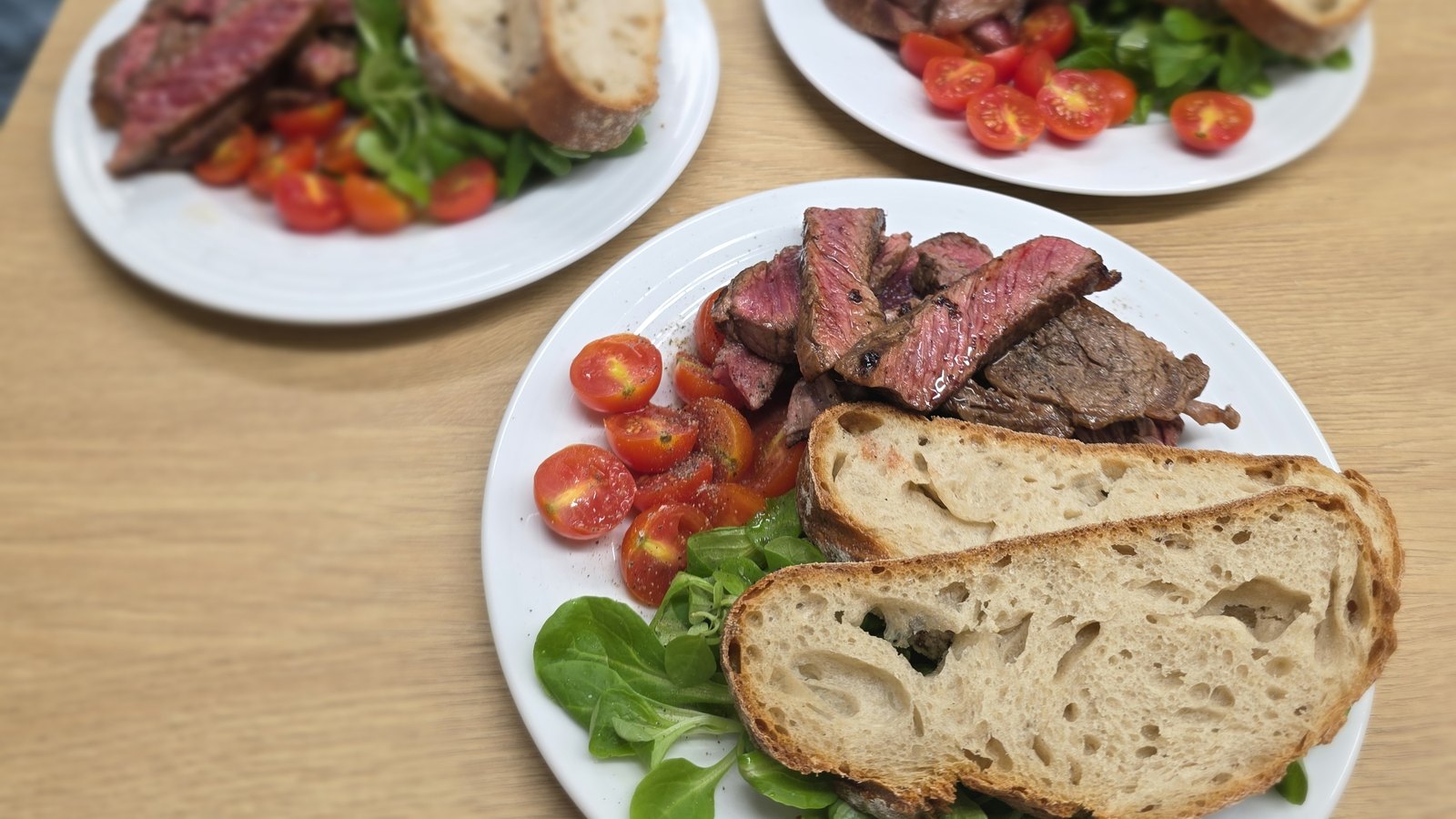
A photo taken on the evening of 9 October 2026 during a trip to Pastviny in the Orlické hory mountains shows three white plates on a wooden table. Each holds slices of beef steak ranging from pink to well done, with a dark seared crust. The meat is served with slices of sourdough bread, halved cherry tomatoes and lamb’s lettuce.
In the table below, the pink centre corresponds to medium rare to medium and sits below the 63 °C threshold recommended by the USDA. With a whole, intact piece of beef, however, the situation is different from minced meat.
Steak is sliced across the grain because shorter fibres are easier to chew. America’s Test Kitchen (ATK) measured more than four times less bite force for flank steak sliced across the grain. After you take it out of the pan, it needs a few minutes’ rest, during which the temperature inside the meat evens out.

Table of contents
Why slice steak across the grain
You can recognise the grain as parallel lines on the surface of the meat. According to ATK, turn the piece so that the lines run away from you and slice at right angles to them. ATK compares this to cutting a bundle of spaghetti into shorter pieces.
ATK cooked flank steak in a water bath at 54 °C and used a texture analyser to measure the force needed to bite through a 5-millimetre slice. Slices cut across the grain needed 383 grams of force, while slices cut along the grain needed 1,729 grams.
With the more tender strip loin, the difference was smaller, 329 grams against 590 grams. According to ATK, rib eye and fillet are tender however you slice them, but with tougher cuts such as flank, slicing across the grain matters. Slice tougher meat thinly, ideally at a slight angle.
Why rest a steak and for how many minutes
ATK grilled four steaks, rested two of them for 10 minutes and sliced the other two straight away. The rested steaks released 40% less juice, while the meat sliced straight away looked greyer and was less tender.
Daniel Gritzer, editorial director of Serious Eats, pointed out in an article from 22 July 2025 that earlier tests sliced steaks at different temperatures because carryover cooking was still happening inside. Chris Young, co-author of Modernist Cuisine, sliced meat at the same temperature and the same amount of juice was lost whether it had rested or not.
In Gritzer’s tasting, four tasters over 30 rounds picked the rested pork chops as juicier 16 times, which is the same as a coin toss. Resting therefore mainly evens out the temperature in the meat. Serious Eats, ATK and BBC Good Food recommend resting for about 5 to 10 minutes, but a thermometer gives a more precise answer.
Which cut of beef to choose for steak
BBC Good Food describes sirloin as a premium steak with more flavour than fillet, best cooked medium rare, and rump as the cheapest of the premium steaks, which toughens when cooked beyond medium. Flank is an inexpensive cut, best cooked to medium at most.
In Czech butchery terms, rib eye comes from the fore rib (vysoký roštěnec), sirloin from the striploin (nízký roštěnec) and rump from the rump (květová špička), according to Czech Wikipedia. Whether you are pan-frying rump steak or rib eye, choose a piece at least 3.8 cm thick. According to Serious Eats, a thinner piece overcooks before it develops a crust.
Serious Eats allows one steak weighing 340 to 450 g for two people, which means 170 to 225 g of meat per person. Look for marbling, because according to Serious Eats most of beef’s flavour is in the streaks of fat. You can read more about meat quality in our guide how to recognise good-quality food.
Prices are approximate. According to a Vitalia.cz article from 8 June 2026 citing data from the Czech Statistical Office (Český statistický úřad, ČSÚ), the current price of boneless beef hindquarter was around 312 CZK (about 14 USD) per kilo, but this covers the hindquarter as a whole. According to the price list of one butcher’s chain as of 18 October 2026, chilled sirloin cost 559.90 CZK (about 26 USD) and fillet 999.90 CZK (about 46 USD) per kilo.
Beef is a red meat that provides iron and protein. You will find other sources in our overviews of iron-rich foods and sources of protein. If you only eat beef occasionally, take a look at meat substitutes.
How to cook steak in a pan step by step
According to Serious Eats, a large steak at least 3.8 cm thick takes about 8 to 10 minutes in the pan. Thinner pieces need less time, as shown in the table below.
- Pat the meat dry with kitchen paper and salt it at least 40 minutes before it goes into the pan (Serious Eats).
- You do not need to take the steak out of the fridge in advance (Serious Eats measured a temperature rise of only 2 °C after half an hour).
- Use a neutral oil, such as sunflower oil (BBC Good Food).
- Heat a heavy pan, ideally cast iron, until it starts to smoke (Serious Eats).
- Turn the steak every minute or more often (BBC Good Food; Serious Eats suggests as often as every 15 seconds, which cuts cooking time by a third).
- At the end, add butter and herbs, such as thyme or rosemary, and baste the meat with them (Serious Eats; the milk proteins in butter burn at high temperatures).
- Insert a thermometer from the side into the centre of the piece and take the steak out according to the table (ATK).
- Rest the steak under loosely tented foil (ATK).
The slices in the photo are served with sourdough bread and lamb’s lettuce with tomatoes. For ideas on baking bread at home, see our homemade bread recipes.
What temperature and how many minutes per side
The temperatures come from an ATK table and show the thermometer reading when the steak comes out of the pan and after resting. The pink slices in the photo correspond to the medium rare to medium rows. The minutes are approximate and based on BBC Good Food timings.
| Doneness | Remove from pan (°C) | After resting (°C) | Minutes per side, 2 cm sirloin | Minutes per side, 3.5 cm fillet |
|---|---|---|---|---|
| Rare | 46 to 49 | 49 to 52 | 1,5 | 2,25 |
| Medium rare | 49 to 52 | 52 to 54 | 2 | 3,25 |
| Medium | 54 to 57 | 57 to 60 | 2,25 | 4,5 |
| Medium well | 60 to 63 | 63 to 66 | No data | No data |
| Well done | 66 to 68 | 68 to 71 | 4 to 5 | No data |
The minutes apply to turning once a minute, as BBC Good Food recommends. Turning more often shortens the cooking time. BBC Good Food also aims for much higher temperatures, giving 63 °C for medium rare and 71 °C for medium, so the thermometer and your own preference decide the level of doneness.
Why steak turns out tough or grey
A tough or grey steak usually has one of the following causes. According to ATK, meat sliced straight after grilling was greyer and less tender.
- A piece that is too thin overcooks before a crust forms (Serious Eats).
- An overcrowded pan. BBC Good Food advises cooking one or two pieces at a time.
- Judging by eye. According to BBC Good Food, there are only a few minutes between rare and well done.
- Slicing along the grain makes each bite tougher (ATK measured bite force).
If you do not have a thermometer, you can cut into the steak and look inside. According to Serious Eats, the loss of juice is small.
Why a whole piece can be pink inside but minced meat cannot
The Food Safety and Inspection Service (FSIS) of the US Department of Agriculture (USDA) recommends an internal temperature of 145 °F (62.8 °C) for beef steaks and roasts, with a rest of at least 3 minutes, and 71 °C for minced meat. According to FSIS, the temperature stays the same or rises slightly during resting.
A pink centre is only acceptable in a whole, intact piece. According to FSIS, in mechanically tenderised beef, which has been pierced with needles or blades, bacteria from the surface get inside, so it must be cooked to 145 °F (63 °C) with a 3-minute rest. Our editors recommend the same caution with injected, marinated and rolled meat.
An undated record from the USDA National Agricultural Library describes a British project by the University of Nottingham funded by the AHDB (Agriculture and Horticulture Development Board). According to the record, muscle tissue is considered sterile and bacteria reach the surface during butchering, so the surface temperature of a seared steak should in theory be enough. In minced meat, bacteria are mixed throughout the whole piece.
The record also states that this conclusion relies on a sterile interior and a sufficiently heated surface, and identifies the transfer of bacteria by tongs from the raw surface to the seared one as a risk. Use separate tongs for raw meat and for the finished steak.
According to FoodSafety.gov (reviewed on 14 August 2025), food poisoning is more likely in pregnant women, people aged 65 and over, children under five and people with weakened immune systems. For them, it recommends cooking meat to at least the safe minimum temperature, which is at least 63 °C.
On 20 July 2011, the Food Safety portal (Bezpečnost potravin) of the Ministry of Agriculture (Ministerstvo zemědělství) published an article by Irena Suková on recommended meat temperatures when frying, which says the following about the outward appearance of meat and thermometers.
“The outward appearance of fried meat often does not accurately indicate its internal temperature, so it is recommended to use thermometers inserted into the meat so that they measure the temperature at the slowest-heating point (they must not touch bone or fat).”
The colour of the cut surface on your plate says nothing about safety. According to FSIS, it is an unreliable indicator. Only a thermometer inserted into the centre of the steak reliably shows the internal temperature.
USD amounts are approximate, converted at the Czech National Bank rate of 21.75 CZK per USD on 9 October 2026.

