
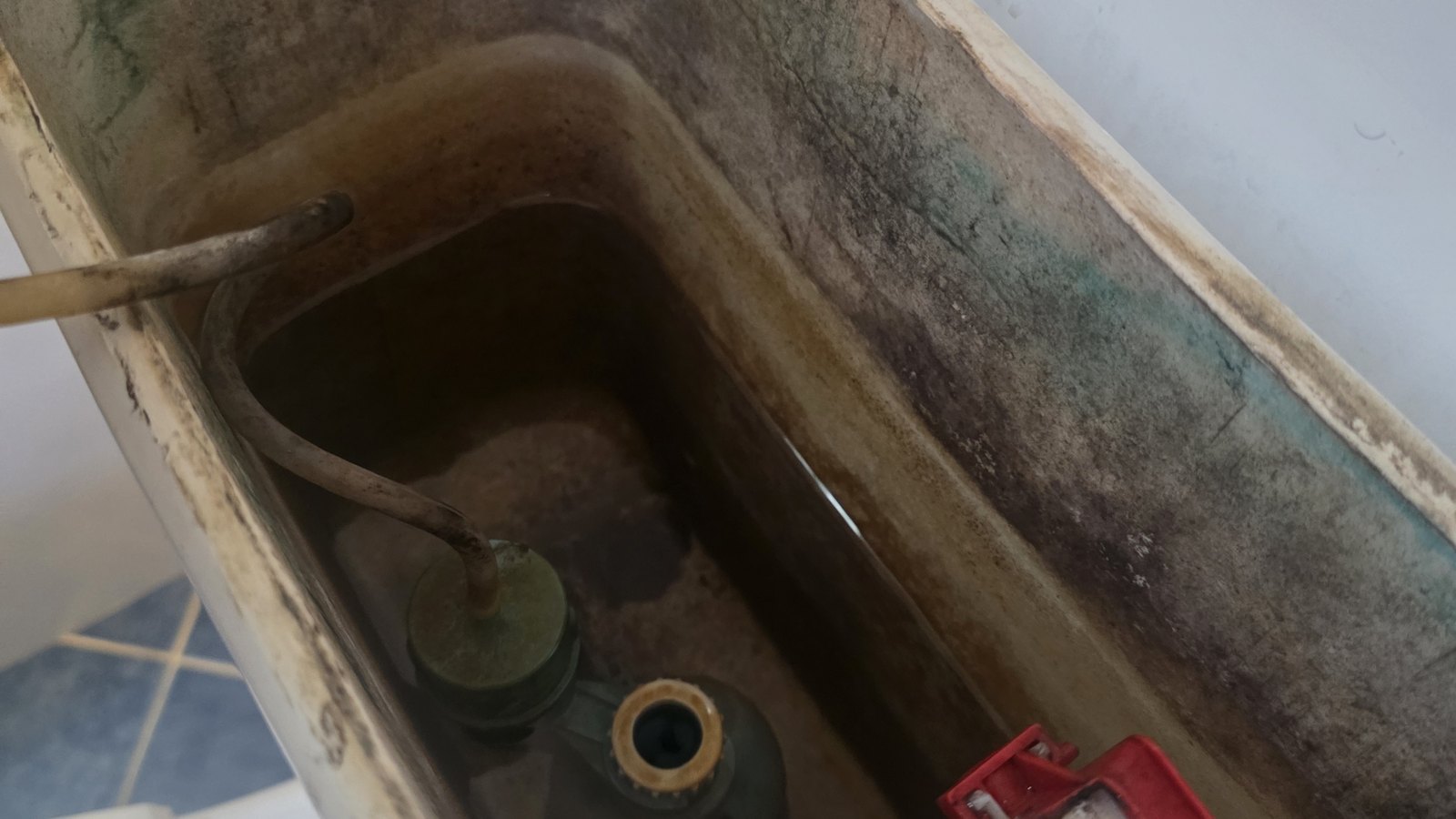
Our photo from 13 October 2026 shows the open ceramic cistern of an older toilet. The walls are covered in brown and black deposits, a rusty stripe runs along the top and there is a greenish tinge on the right. A bent metal rod leads to a green disc, next to it is a brass ring with a dark opening, and there is a red part in the corner.
This is what a cistern looks like when nobody has opened it for years, and it caught our attention because of how much money can be hidden in a place nobody looks. A running toilet with a heavy leak lasting all year costs up to 114,763 CZK (about 5,300 USD) a year, and a light leak around 8,647 CZK (about 400 USD). A plumber’s repair costs 896 to 2,016 CZK (about 41 to 93 USD) for labour including VAT, and a new fill valve costs about 200 CZK (about 9.2 USD).
Table of contents
How much water and money a running toilet flushes away each year
Prague Water Supply and Sewerage (Pražské vodovody a kanalizace, PVK) distinguishes between a slightly running cistern, meaning 150 to 1,000 litres a day, and a heavily running one, meaning 1,000 to 2,000 litres a day. It uses the water and sewerage charge of 157.21 CZK (about 7.2 USD) per cubic metre, valid from 1 January 2026. Hornbach also gives one litre of water per minute, which is 1,440 litres a day, as a possible flow rate.
 How much a kilowatt hour of electricity costs: the price is around 6 CZK (about 0.28 USD)
 How much the waste fee is for pensioners in 5 large cities
The US agency EPA writes that 9% of American households have leaks of 50 gallons a day or more, which is about 190 litres. According to a leaflet from the Prague 14 district (městská část Praha 14), one flush uses up to 10 litres of water, so a small leak equals roughly 15 extra flushes every day. For more tips, see our article on how to save money on water at home.
| Leak | Litres per day | Cubic metres per year | Prague, 157.21 CZK (about 7.2 USD) per m³ | Plzeň, 115.21 CZK (about 5.3 USD) per m³ | Ostrava, 112.99 CZK (about 5.2 USD) per m³ |
|---|---|---|---|---|---|
| Small, slightly running, lower limit | 150 | 55 | 8,647 CZK (about 400 USD) | 6,337 CZK (about 290 USD) | 6,214 CZK (about 290 USD) |
| Medium, slightly running, upper limit | 1 000 | 365 | 57,382 CZK (about 2,600 USD) | 42,052 CZK (about 1,900 USD) | 41,241 CZK (about 1,900 USD) |
| Large, heavily running, upper limit | 2 000 | 730 | 114,763 CZK (about 5,300 USD) | 84,103 CZK (about 3,900 USD) | 82,483 CZK (about 3,800 USD) |
Water and sewerage charges are for 2026 including VAT, and the leak runs continuously all year. We take the Prague amounts and the number of cubic metres from the PVK overview. Plzeň and Ostrava are recalculated using prices from Finance.cz dated 9 February 2026, without the flat water meter fee.
In Prague, this is 23.58 CZK (about 1.1 USD) a day for a small leak, 157 CZK (about 7.2 USD) for a medium one and 314 CZK (about 14 USD) for a large one. However, a toilet usually only runs until someone notices it, so a whole year is an upper estimate.
How to tell if your toilet is running
The most reliable method is to colour the water. The EPA advises putting a few drops of food colouring into the cistern and waiting ten minutes. If the colour appears in the bowl, the toilet is running. Flush straight after the test so the dye does not stain the cistern, and make sure nobody flushes in the meantime.
You can also do a quick check without dye. Place a sheet of toilet paper on the dry back wall of the bowl, and if it gets wet without flushing, water is running down the wall from the cistern. A lighter leak sometimes only shows itself by the cistern refilling repeatedly for no reason, and a heavy one by a constant hissing sound.
The third method is the water meter. The EPA advises noting the reading, not using any water for two hours and then comparing the reading, because if the meter has moved, water is leaking somewhere. In a flat, you can also do this overnight. If the meter is moving, close the toilet’s angle valve and repeat the test. If it stops, you have found the culprit.
Why a toilet runs, from the float to the valve seal
The green disc on the bent rod looks like a float. The float shuts off the water supply once the water reaches the right level, and a damaged or badly adjusted float shuts it off too late. The water level then rises to the overflow and water drains into the bowl, so nobody sees the leak, they only hear the hissing.
Next to the float is a brass ring with a dark opening, which belongs to the valve. The seal must sit on the valve seat with its whole surface, and when the rubber hardens over the years or deposits build up on the seat, the valve stops sealing. Water then leaks into the bowl and the fill valve keeps topping it up.
According to ČESKÉSTAVBY.cz, a running toilet is usually caused by a leaking flush mechanism, a rubber seal that does not fit properly, a damaged float or a faulty valve. Sometimes it is enough to clean off limescale or a slimy film, says Hornbach.
How to clean a cistern with brown and black deposits
The brown and black deposits on the walls, the rusty stripe at the top and the greenish tinge on the right look like a combination of limescale and film. According to the Toxicological Information Centre of the General University Hospital in Prague (Toxikologické informační středisko VFN), limescale removers contain various acids, mainly weak organic ones such as acetic or citric acid. Put on rubber gloves and follow these steps.
- Close the water supply with the angle valve and empty the cistern by flushing.
- Remove the lid. On some toilets, you first need to unscrew the control cover or the button.
- Wash the float and valve in hot water with washing-up liquid and rinse them.
- Clean the walls and bottom wherever you can reach. Vinegar or citric acid helps with limescale, and soda helps with film.
- Check the seal and valve, replace any damaged parts, reassemble the cistern and turn the water back on.
Toilet cleaners are sold both with sodium hypochlorite and with acids. The Toxicological Information Centre of the General University Hospital in Prague warns that they must never be mixed, as this can release chlorine gas.
When cleaning a cistern, this means not adding vinegar or citric acid to water that still contains a chlorine cleaner, and rinsing the cistern thoroughly between the two methods. Keep the room ventilated while you work. If you have problems after inhaling the gas, call the 24-hour Toxicological Information Centre on 224 919 293 or 224 915 402, and in serious cases call the emergency medical service on 155.
When cleaning is enough and how much a new valve or a plumber costs
Cleaning is enough if the seal keeps its shape and the valve is only clogged with limescale. If the rubber is hard or cracked, or the toilet keeps refilling after cleaning, the seal or valve needs replacing. For older systems, Hornbach recommends replacing these parts every 10 to 15 years.
According to Hornbach, a new fill valve costs about 200 CZK (about 9.2 USD) and replacing it takes just a few minutes, so if you do it yourself, you only pay for the part. A plumber charges for labour, as shown by the 2026 price list of the firm InstalatérTeam from Nymburk. The prices are for labour without materials and are listed without VAT in the price list. In the table, they are also recalculated with 12% VAT.
| Plumber’s labour, Nymburk | Excluding VAT | Including 12% VAT |
|---|---|---|
| Toilet flush repair, fill or flush valve, float | 800 to 1,800 CZK (about 37 to 83 USD) | 896 to 2,016 CZK (about 41 to 93 USD) |
| Minimum charge | 900 to 1,500 CZK (about 41 to 69 USD) | 1,008 to 1,680 CZK (about 46 to 77 USD) |
| Hourly rate, plumbing and heating | 500 to 700 CZK (about 23 to 32 USD) | 560 to 784 CZK (about 26 to 36 USD) |
With a light leak of 150 litres a day, water in Prague costs 23.58 CZK (about 1.1 USD) a day, so a repair costing 896 to 2,016 CZK (about 41 to 93 USD) plus a 200 CZK (about 9.2 USD) part pays for itself in 46 to 94 days. With a leak of 1,000 litres a day, which is 157 CZK (about 7.2 USD) a day, it takes 7 to 14 days.
A second call-out costs the minimum charge again, which is 1,008 to 1,680 CZK (about 46 to 77 USD) including VAT. If both the flush valve and the fill valve are worn, it is therefore worth replacing them at the same time. Have the price confirmed in advance. How to avoid extra charges is explained in the article The repair cost more than you agreed.
Who pays for repairs in a rented flat
Under the Civil Code (občanský zákoník), the tenant pays for minor repairs and routine maintenance of the flat, and these are defined by Government Regulation No. 308/2015 Coll. (nařízení vlády č. 308/2015 Sb.). Under Section 2, cleaning the cistern is routine maintenance, and Section 4(g) and (i) classify repairing the flush mechanism and replacing its small parts as minor repairs. The tenant pays for both.
“Minor repairs are repairs to the flat and its internal fittings, provided these fittings are part of the flat and are owned by the landlord, according to their factual definition or the amount of the costs.” Government Regulation No. 308/2015 Coll., Section 3
Repairs not listed in Section 4 count as minor up to 1,500 CZK (about 69 USD) per repair (Section 5), and the total cost of minor repairs per year must not exceed 150 CZK (about 6.9 USD) per square metre of floor area (Section 6). Both limits apply from 1 January 2026. Previously, they were 1,000 CZK (about 46 USD) and 100 CZK (about 4.6 USD) per square metre.
In a 50 square metre flat, the annual limit is 7,500 CZK (about 340 USD), and any further repairs that year no longer count as minor and are paid by the landlord. Cleaning does not count towards the limit, because it is routine maintenance, and neither do travel costs, which the tenant pays. Fix a running toilet straight away, and report to the landlord any fault not named in Section 4, such as cracked ceramics, a concealed cistern module or replacing the whole bowl.
Record the condition of the toilet in the handover report when you move in, and put any agreement on repairs in the tenancy agreement or its addendum. Household savings are also summarised in the article on how to reduce your running costs.
 Motorway vignette set to stay at 2,570 CZK (about 120 USD) from January, Senate to decide
 How much a grave costs: in Prague, rent of up to 134 CZK (about 6.2 USD) per square metre
 How much new windows cost and who gets a subsidy of 8,000 CZK (about 370 USD) per m²
 How much a dog costs per year: a small breed comes to 14,000 CZK (about 640 USD)
 How much a flat costs: a square metre in Prague is offered for 154,000 CZK (about 7,100 USD)
USD amounts are approximate, converted at the Czech National Bank rate of 21.75 CZK per USD on 9 October 2026.

