
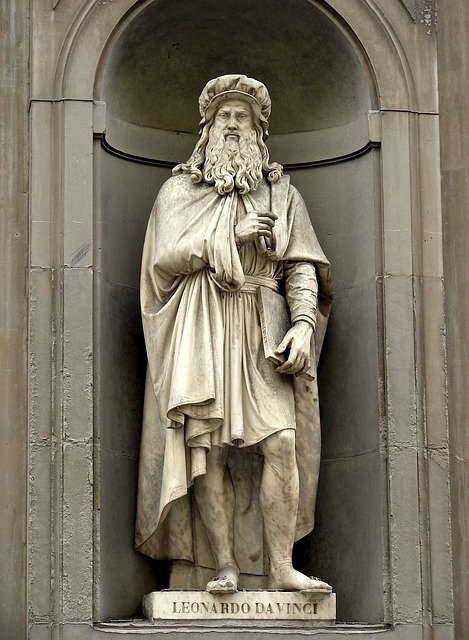
When you look back at the history of art and science today, the name of one of the most successful Italians probably comes to mind. He was a man who brought together the worlds of art and invention like few others, Leonardo da Vinci. This Italian Renaissance genius not only left an unforgettable mark on painting but also represented an amazing combination of creativity, vision and scientific enquiry. Thanks to his artistic talent and brilliant ideas, our world changed not only in an aesthetic sense but also in a technological one. Let’s dive into the life and work of Leonardo da Vinci.
Table of contents
The life of Leonardo da Vinci
Name: Leonardo di ser Piero da Vinci
Date and place of birth: 15 April 1452, Anchiano (Italy)
Date and place of death: 2 May 1519, Amboise (France)
Who was this versatile genius who made his mark on history? His life story is like a painted picture full of curiosity, creativity and a tireless thirst for knowledge.
Leonardo was born in the small village of Anchiano near the town of Vinci. His father worked as a lawyer, his mother as a peasant, and Leonardo was their only child. However, he was not an only child, as he had 17 half-siblings in total. His unusual talent soon attracted attention. Even in his youth, he showed a remarkable ability to observe and an immense interest in nature. His drawings were the embodiment of the detail and precision that later made him famous.
Thanks to his abilities, he soon joined the workshop of the famous artist Andrea del Verrocchio of Florence, where Leonardo learned to paint, sculpt and experiment with new techniques. Before that, he had no other education apart from reading, writing and arithmetic.
His thirst for knowledge was endless, so he also took up the study of anatomy and other scientific research. His notes from that time contain not only sketches of muscles and organs but also studies of the movement of the human body and of mechanisms.
Around 1482, he began painting his first commissioned works. His works of art are among the most famous paintings of all time. However, he was not just a painter. He was also an engineer, an inventor and a visionary. At that time, he moved to Milan, where he worked for the Sforza family. He designed futuristic machines, bridges and military technology that were far ahead of their time. This is shown by his sketches of flying machines and underwater vessels.
Masterpieces
Leonardo da Vinci’s paintings are not just paintings, they are windows into the human soul. He filled his paintings with profound ideas, emotional depth and his incredible power of observation.
Mona Lisa
The Mona Lisa (La Gioconda in the original) is an iconic painting of a woman who captivates with her mysterious smile. Leonardo created the portrait with incredible precision and delicacy. Looking at the painting, it seems that the woman is hiding countless secrets. In the past, she was thought to be the courtesan Mona Lisa Gherardini, but current research states that she was Lisa del Giocondo, the wife of a Florentine merchant. The Mona Lisa belonged to a series of portraits that Leonardo da Vinci created after fleeing from Milan to Venice and then to Florence. Today, the portrait is kept in the Louvre in Paris, where you can see it with your own eyes.
The Last Supper
The Last Supper was created in Milan between 1495 and 1498. The painting depicts the last meeting of Jesus with his apostles before his crucifixion. Each apostle has his own reaction to Jesus’s words about betrayal, and this drama is beautifully expressed through the movements and expressions of the figures. The work was painted in tempera and oil on plaster and was created for the refectory of the city’s monastery of Santa Maria delle Grazie.
Vitruvian Man
The sketch of a man in a circle and a square symbolises the connection between the human body and architecture. The image highlights Leonardo’s scientific approach to art and his desire to understand the laws of the world around us.
Madonna
This painting of the Madonna is unique in that it shows the Virgin Mary and Jesus in the setting of a natural rocky cave. It combines human and natural elements into a unique whole. The Madonna is portrayed as a gentle and protective mother, while the setting evokes the wild and untamed beauty of nature.

💡 Do you know how much the most expensive paintings in the world sell for?
Da Vinci’s notebooks
Leonardo filled his notebooks with four subjects (painting, architecture, mechanics and human anatomy). He produced thousands of pages of neatly drawn illustrations and densely written commentary, some of which others could not decipher because of his left-handed mirror writing.
His famous notebooks include the Codex Atlanticus, which contains a design for a mechanical bat 20 metres long. It is essentially a flying machine based on the physiology of a bat and on the principles of aeronautics and physics.
Other notebooks contained anatomical studies of the human skeleton, muscles, brain and the digestive and reproductive systems, which brought new knowledge about the human body to a wider audience. However, because they were not published in 1500, da Vinci’s notebooks had little influence on scientific progress during the Renaissance. His manuscripts are now held in museum collections.

Inventions
Leonardo da Vinci was constantly looking for new ways to improve the world around him. Although many of his ideas were only realised many years after his death, his legacy in science, technology and art remains an inspiration to this day.
Tanks
Although his tanks never saw a battlefield in his time, his concepts influenced later military technology. His designs also included prototype tanks (armoured vehicles with firearms that were powered by human strength).
Flying machines
Leonardo immersed himself in the world of birds and their flight. In his diaries, you will find not only detailed drawings of wings but also plans for various machines for human flight. These range from giant winged machines to helicopters and prototype parachutes. Although most of his ideas remained only on paper, his visions of flight became an inspiration for future scientists and engineers.
The world beneath the surface
When he was not soaring through the sky, he considered what might lie beneath the surface of the water. He designed an underwater diving suit that would allow people to explore the seabed without having to surface for every breath. It was based on an airtight sphere with an air supply from the surface.
Bridges
As well as being a dreamer, he was also a practical engineer. He designed bridges to span rivers and valleys. They were exceptionally innovative and used the principles of arched structures.
The end of a genius’s life
In 1516, da Vinci left Italy for good when the French king Francis I generously offered him the title of First Painter, Engineer and Architect to the King, which allowed him to paint and draw in his spare time while living at a country residence near Amboise in France. Although he was accompanied by Melzi, his close friend, da Vinci’s final years were not happy.
Da Vinci died in Cloux in 1519 at the age of 67. He was buried nearby in the castle church of Saint-Florentin. The French Revolution almost destroyed the church, and its remains were completely demolished in the early 19th century, which made it impossible to identify da Vinci’s grave precisely.
💡 Tip: Read our article on Egyptian symbols and their meaning in the modern world.
Leonardo da Vinci was undoubtedly one of the greatest figures in human history. Probably because of his many and varied interests, da Vinci did not manage to complete a considerable number of his paintings and projects. His paintings and inventions changed the world not only aesthetically but also technologically. His works remind us that searching for new paths and connections between seemingly separate fields can lead to revolutionary discoveries. In his legacy, you can find the motivation never to give up on your dreams and to keep pushing the limits of what is possible.

