
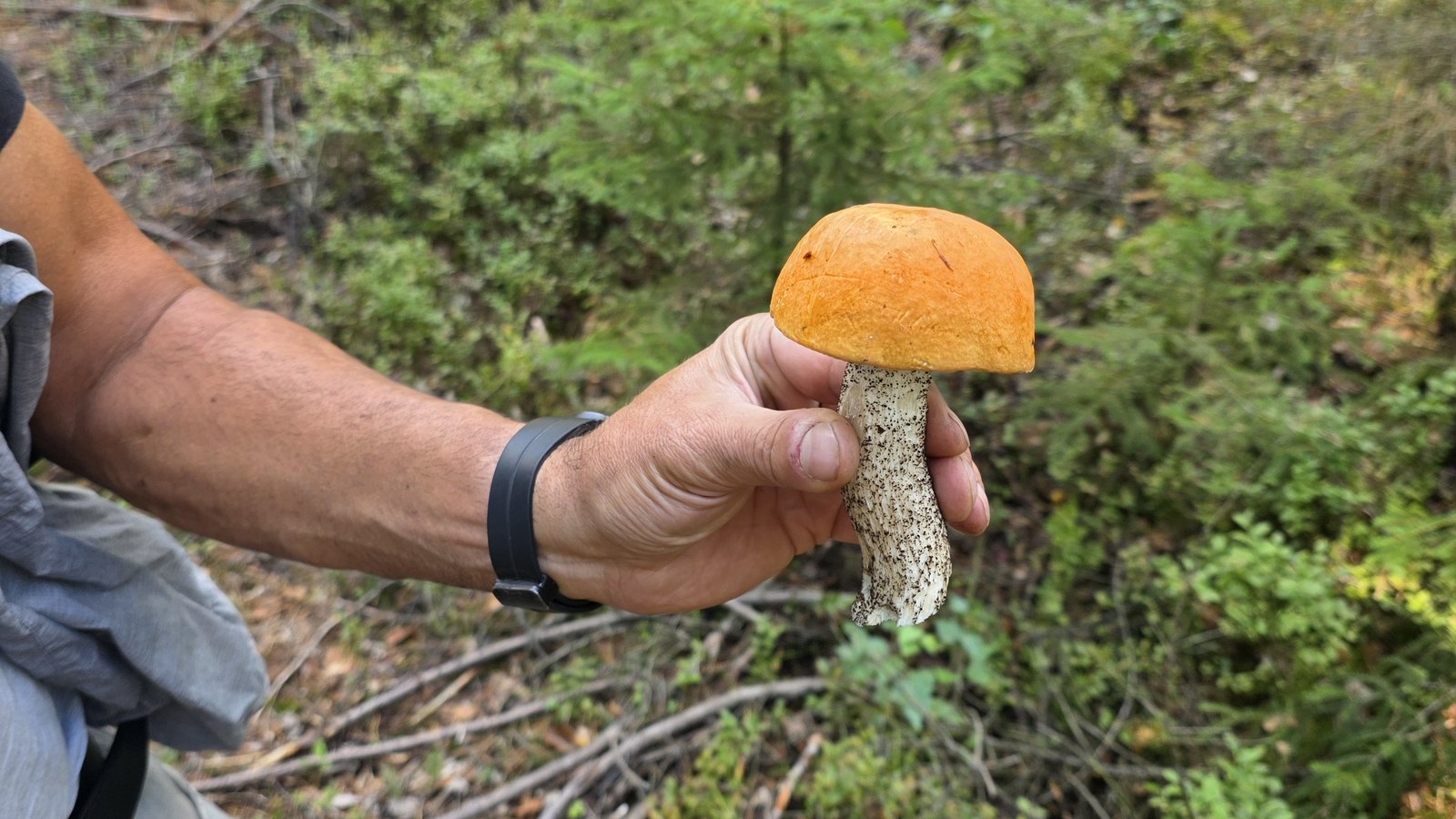
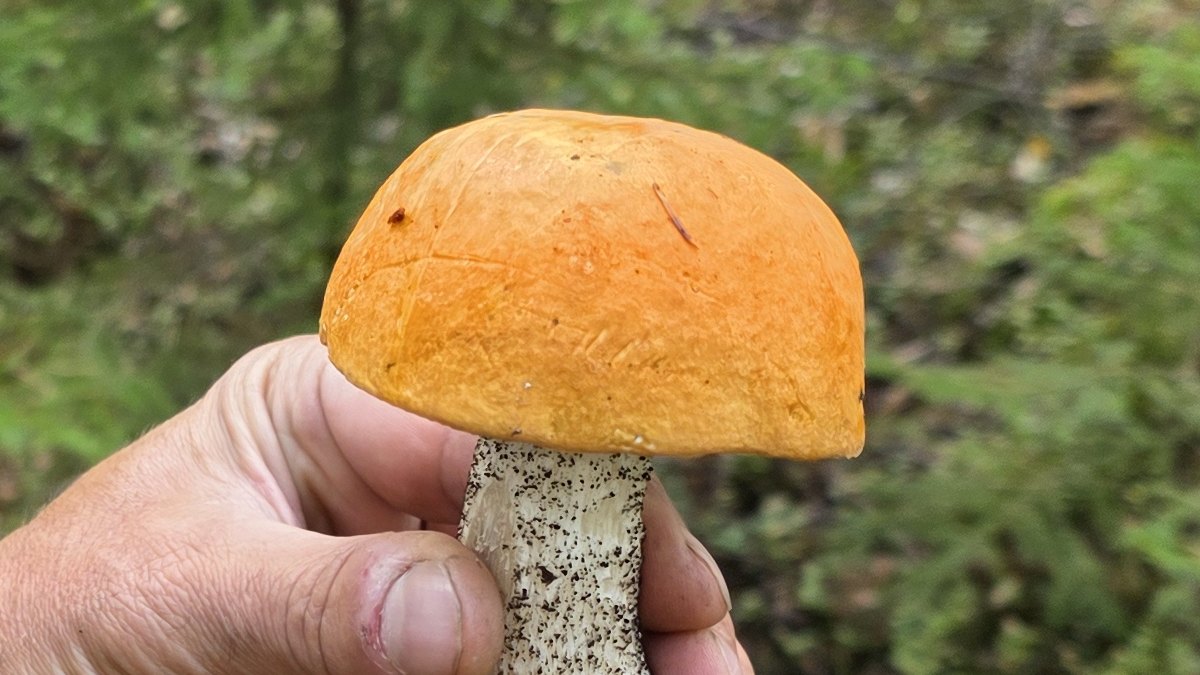
You can recognise the orange birch bolete by its orange cap and its white stem densely covered in black scales. It grows only under birch trees and has no poisonous lookalike; it resembles only a few other orange boletes, which are also edible. Eat it only when it is properly cooked and only when you are certain of your identification.
In our view, it is the most beautiful mushroom in Czech forests. We love the contrast of the bright orange cap and the black-speckled stem against green bilberry bushes. The photo we are working from was taken on 14 September in a forest near Vysoká Libyně in the Plzeň region.
We are not alone in this. The atlas of the Czech Mycological Society (Česká mykologická společnost), whose texts are written by Karel Tejkal, describes it as “an excellent and widely prized edible mushroom, with a beautifully striking cap colour and generally robust fruiting bodies”.
 Discover the chaga mushroom and its effects
 Pearl barley: A healthy grain from our grandmothers’ kitchens
Table of contents
How to recognise the orange birch bolete
According to the atlas, the cap measures 40 to 200 mm. At first it is hemispherical, and later it becomes cushion-shaped. Its colour ranges from yellowish orange through reddish orange to orange-brown, and the surface is matt, felty and usually dry.
In young mushrooms, the cap skin extends over the edge towards the stem, but this overhang disappears later. The tubes under the cap are up to 25 mm long and have small round pores, greyish brown when young and whitish later.
The main identifying feature is the stem. It is elongated and club-shaped, 80 to 220 mm tall, and from a young age it is covered in contrasting greyish-black scales that look like dense black dots on the white background.
The flesh is whitish. When cut, it turns pink, blue-green at the base of the stem, and then continues to darken. However, a description from an atlas is no substitute for identification at a mushroom advice centre; you will find its contact details below.
Where and when to find it
The Czech Mycological Society’s atlas states that it appears from May to October, while Czech Wikipedia says from June. The orange birch bolete grows in deciduous and mixed forests, in copses and on grassy verges along paths, always under birch trees. There is no point looking for it where there are no birches.
The forest where our photo was taken has birches, young spruces and bilberry bushes. Mushroom picking is also a long walk among the trees; we write about what time in the forest does for your body and mind in our article on forest bathing.
Orange birch bolete, aspen bolete, red-capped scaber stalk and brown birch bolete
Beginners most often confuse the various orange boletes with one another and with scaber stalks. Cap colour overlaps among orange boletes, so the deciding factors are mainly the scales on the stem and the tree the mushroom grows under.
| Species | Cap | Stem scales | Tree |
|---|---|---|---|
| Orange birch bolete | yellowish orange, reddish orange to orange-brown | greyish black from a young age | birch |
| Aspen bolete | orange-red | white when young, darkening only later | poplars, especially aspen |
| Red-capped scaber stalk | brick red | rusty to reddish brown from a young age | aspen, poplar, oak |
| Brown birch bolete | ochre-brown to brown | greyish brown to black | birch |
The spruce bolete grows under spruces and the pine bolete under pines; both have stem scales that are more brown than black. The easiest way to tell an orange bolete from a brown birch bolete is to cut it open. The flesh of the brown birch bolete does not change colour, while the flesh of an orange bolete turns pink and darkens.
The atlas rates the brown birch bolete as an excellent edible mushroom and recommends picking only younger specimens. It grows from June to November under the same trees as the orange birch bolete, so you will often find them in the same spot.
Does the orange birch bolete have a poisonous lookalike?
No. According to the Czech Mycological Society’s atlas, the orange birch bolete can in practice only be confused with another species of orange bolete. Such a mix-up does not matter to mushroom pickers, because all orange boletes are edible and taste similar.
So the risk lies not in a similar mushroom but in uncertainty and in the kitchen. Do not pick anything you cannot identify with certainty, and never eat any orange bolete raw or undercooked.
For certainty in identification, visit a local mushroom advice centre or ask an experienced mycologist in your area (in the Czech Republic: the mushroom advice centre of the Czech Mycological Society at Karmelitská 14, Prague 1, open all year on Mondays 9 am to 12 noon and 2 pm to 6 pm and on Thursdays 9 am to 12 noon, and from June to November also on Tuesdays 9 am to 12 noon).
It is closed on public holidays. Identification is free for members of the society, while others pay 20 to 50 CZK (about 0.92 to 2.3 USD) depending on the number of species. The advice centre is not a medical service; if you suspect poisoning, seek medical help immediately.
Why it turns black and how to prepare it
Darkening flesh is typical of this species, and the atlas mentions it directly in its description. The cut surface first turns pink and slowly darkens, and the orange birch bolete turns black when cooked or dried. Safety depends on the freshness of the mushroom and thorough cooking, not on its colour.
Do not eat orange birch boletes raw. In August 2023, mycologist Libor Hejl advised TN.cz readers to cook wild mushrooms for at least 20 to 30 minutes, and this is also the safest rule for orange boletes.
In August 2020, toxicologist Hana Farná from the Toxicological Information Centre (Toxikologické informační středisko) told Novinky that the centre constantly deals with false poisonings caused by mushrooms that were poorly stored, spoiled, insufficiently cooked or raw.
Pick mainly young, firm specimens. According to the atlas, in older mushrooms the flesh of the cap softens and the stem becomes fibrous or even woody. The orange birch bolete is one of the mushrooms approved for sale, so it can also be sold at markets.
For freezing, Novinky.cz (Zboží magazín, 25 October 2025) advises cutting cleaned mushrooms into equal pieces, braising them in a pan for at least five minutes, letting them cool and then packing them. Frozen mushrooms are best used within three to six months.
Mushrooms can also be dried; you will find instructions in our article on drying fruit, vegetables and mushrooms. Cooked orange birch boletes work well in soups, autumn dishes and meat-free meals. For more ideas on cooking mushrooms, see our oyster mushroom recipes.
How to carry and store mushrooms, and what to do if you feel unwell
Put young, healthy mushrooms in a wicker basket and process wild mushrooms within two to three days of picking at the latest, advises Novinky.cz. The Toxicological Information Centre warns that even edible mushrooms can cause problems if they are insufficiently cooked or poorly stored.
If you suspect poisoning, call the Toxicological Information Centre, available around the clock, on 224 919 293 or 224 915 402. Have the details of the case ready, along with the affected person’s full name, birth number and health insurance company. If symptoms are severe, call the emergency medical service on 155.
Hana Farná recommends keeping samples, meaning any leftover mushrooms or remains of the meal. The centre also advises keeping an eye on small children while picking so that they do not taste any mushrooms.
 TOP 7: Oyster mushrooms and their magical effects
 Febrile seizures: What do they look like and how to handle them?
 The moldavite phenomenon: Which is the most expensive and the largest?
 How to hide post-Christmas pounds? Fashion tips on what to wear!
 7 tips: Discover a notable chateau in Central Moravia
USD amounts are approximate, converted at the Czech National Bank rate of 21.75 CZK per USD on 9 October 2026.

