

To run a successful business, you need effective tools and strategies for analysing your competition. One of the most respected and widely used tools is Porter’s Five Forces model. Developed by Professor Michael E. Porter at Harvard Business School, this model gives you a framework for understanding and assessing the competitive forces that affect your industry. Let’s look at what the model involves and how you can use it effectively in your business.
Table of contents
What is Porter’s model?
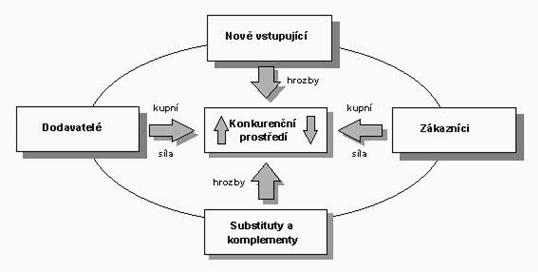
Porter’s Five Forces model is an analytical tool that helps entrepreneurs and managers better understand the dynamics of their industry. The model identifies five key forces that shape the competitive environment and affect business profitability. These are:
- Threat of new entrants
- Bargaining power of suppliers
- Bargaining power of customers
- Threat of substitutes
- Competitive rivalry
Who is behind this model? As mentioned above, the five competitive forces were defined by Michael Porter in 1979 in an article published in the Harvard Business Review. In an effort to capture the complexity that real strategists would face while keeping strategic analysis manageable, Porter set out five forces that operate within a given industry.
Now let’s go through each force.
1. Threat of new entrants
When new competitors enter an industry, they often bring new capacity and innovation, which can reduce the profitability of existing companies. New players usually try to win market share by lowering prices or improving quality. Barriers to entry, such as high capital requirements, access to distribution, government regulation, patents, customer loyalty and economies of scale, determine how easily new players can enter the market. Higher barriers to entry mean a smaller threat from new competitors.
2. Bargaining power of suppliers
Suppliers can affect the profitability of companies in an industry by raising the prices of inputs or lowering their quality. If there are few suppliers on the market, if they supply unique products, or if they can easily integrate backwards into the industry (start making the product themselves), suppliers have greater bargaining power. This power allows suppliers to secure better terms and influence how competitive companies are.
3. Bargaining power of customers
Customers want lower prices and demand higher quality or better service, which can reduce the profitability of companies in the industry. Customer power is greater if there are few buyers on the market, if they buy in large volumes, if products are standardised, or if they can easily switch to other suppliers. Greater customer bargaining power means companies must be more flexible and innovative to keep their customers satisfied.
💡Tip: If you have a bricks-and-mortar shop, you can try customer analytics here.
4. Threat of substitutes
Substitutes are products or services from other industries that can meet the same customer need. If available substitutes are cheaper, perform better, or if it is easy and cheap for customers to switch to them, the threat of substitutes grows. A high threat of substitutes can limit prices and profitability, because companies have to compete not only with each other but also with alternative solutions.
5. Competitive rivalry
Intense competition between existing companies can lead to price wars, advertising battles, product innovation and service improvements, which can reduce industry profitability. Rivalry is greater if there are many competitors on the market, if the market is growing slowly (meaning companies must fight for market share), if products are undifferentiated, or if fixed costs are high (which creates pressure to fill capacity).
💡Tip: To better understand this force, use competitor analysis.
Use Porter’s model in your business
Porter’s Five Forces model offers a structured approach to assessing your competitive environment and identifying key areas. Before you start working with it, take the following steps:
- Identify the key players in your industry: Map out suppliers, customers, competitors and potential new entrants to the market.
- Carry out a detailed analysis of each of the five forces: Assess how each force affects your business and how it may change in the future.
- Evaluate threats and opportunities: Identify areas where you can reduce risks or seize opportunities to become more competitive.
- Create a strategic plan : Based on your analysis, design steps that will help you strengthen your market position, for example raising barriers to entry for new competitors or building stronger relationships with key suppliers.
- Monitor and adapt: The market is dynamic, so it is important to review your analysis and strategy regularly based on current changes in the competitive environment.
A practical example of applying Porter’s model
To picture this with a concrete example, look at how Porter’s Five Forces model applies to a marketing agency:
1. Threat of new entrants
Factors affecting the threat: Barriers to entry in the marketing agency industry are relatively low. With modern technology and online tools, new agencies can be set up easily and cheaply.
Strategy to reduce the threat: Investing in innovative services and technology that set the agency apart from the competition. Also building and strengthening relationships with existing clients through excellent customer service and results.
2. Bargaining power of suppliers
Factors affecting the power: Marketing agencies often work with suppliers such as advertising platforms, graphic designers, copywriters and other specialists. If there are plenty of these suppliers on the market, their bargaining power is lower.
Strategy to reduce the power: Diversifying suppliers and creating backup options for key services. Negotiating long-term contracts with suppliers at favourable prices.
3. Bargaining power of customers
Factors affecting the power: Large clients may have greater bargaining power and may demand lower prices or higher service quality.
Strategy to reduce the power: Offering unique, added value that sets the agency apart from the competition.
4. Threat of substitutes
Factors affecting the threat: Customers can use in-house marketing teams or automated marketing tools instead of hiring an external agency.
Strategy to reduce the threat: Investing in the latest technology and marketing tools that deliver better results than in-house teams or automated tools.
5. Competitive rivalry
Factors affecting intensity: A larger number of marketing agencies on the market increases competitive pressure.
Strategy for handling competition: Constantly monitoring the competitive environment and adapting to changes in the market.
Advantages of Porter’s model
- It provides a structured framework for analysing the competitive environment.
- It helps identify the key factors affecting an industry’s attractiveness.
- It can be used for a range of strategic purposes.
- It is relatively easy to understand and use.
Disadvantages of Porter’s model
- It can be overly simplistic and fail to take all relevant factors into account.
- It can sometimes be difficult to gather accurate data for all five forces.
- It can be subjective and depend on the analyst’s interpretation of the data.
💡Tip: Interested in Porter’s Five Forces model? There are other models that can help your business too, such as the 7P marketing mix.
Porter’s Five Forces model is ideal for strategic planning and competitor analysis. It gives you a useful framework for understanding the forces that affect your business. By identifying and analysing the key forces, you can better prepare your business for challenges and take advantage of new opportunities.

